
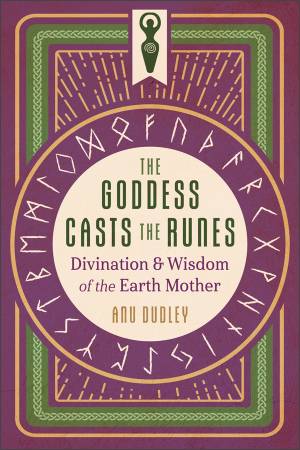
[Today, we sit down with author Anu Dudley. Here, she discusses her personal spiritual practice; her new book, The Goddess Casts the Runes and the research that went into it; and her upcoming projects.]
Forests Haunted by Holiness: How do you define your personal spiritual practice?
Anu Dudley: We celebrate the Wheel of the Year holidays in our Grove throughout the year, and we generally observe Wiccan Reclaiming practices. But, as I often remind my students, we follow no rules, only traditions, and the ethics and principles that these traditions honor. So, I advise them to go where Spirit guides them, and define their spiritual path for themselves as they follow it through their lives.
I think of my own personal practice in terms of Earth-based Spirituality. My altar is the woods in which I live, and my practice is experienced in communion with the trees, the wind, the land, and those that dwell on it. To experience deep connection with the land and the elements is, for me, my spiritual practice.
FHBH: Which deities do you honor?
AD: A few years ago, I taught a course at the University of Maine entitled History of the Goddess. Preparing for this course helped me to focus on the concept of Goddess from yet another perspective, and encouraged me to ponder anew the question, “Do I believe in goddesses?” I concluded that my spiritual practice mainly involves connecting with Spirit, which is unlimited and unquantifiable, rather than with any particular named goddess.
That being said, when I am in need of support or guidance, I often reach out to a specific goddess, for example Isis. This practice, I find, gives me a more tangible and visceral focus so I can connect with the energy I need. I’m only human, after all, and humans relate most comfortably to other humans or human-like beings with whom they can feel a relationship. When Spirit dons the cloak of a specific goddess, then my human mind and heart can better relate to it.
FHBH: Why did you select Inner Traditions to publish your book?
AD: I didn’t select Inner Traditions. They selected me! After one of our Grove’s ceremonies, I got to chatting with one of the participants, Ash McKernan, author of Wyrdcraft, about a book I was writing. He is a friend of Richard Grossinger, an author and editor at Inner Traditions. A week later, I received an email from Richard saying he wanted to talk with me about my book. The rest, as they say, is history. I am deeply honored to have had Inner Traditions take up my book because it’s a perfect fit. Thanks to the Universe for this great gift!
FHBH: How were the runes lost, and how do we go about reclaiming them?
AD: The runes weren’t so much lost as they were stripped of their original Earth-based Spiritual and Mother Goddess meanings and reinterpreted as symbols of Odin-centric mythology and a patriarchal way of looking at the world.
In a way, we can look at how we interpret the runes as an indication of our cultural values and perspectives. Tens of thousands of years ago, our ancestors lived in peaceful and prosperous matri-focal societies that venerated the Earth Mother. The ancient symbols that would become the runes represented these values of caring for, supporting and protecting all beings. But slowly, for reasons we don’t yet fully understand, human society started to change and began glorifying warrior culture, male gods, and might-makes-right ethics.
Reclaiming the runes goes hand-in-hand with reclaiming an Earth-based Spiritual perspective on how we live on this Earth, and rediscovering the Earth Mother‘s presence in the runes.
FHBH: How did you go about dividing the runes into “Birthrights,” “Challenges,” and “Relationships?’
AD: The runes have traditionally been divided into three groups or aettir, the Norse word for kinships. This implies that each of the runes within a given aett share a certain identity with one another, like members of a family. Traditionally, the three rune rows have been linked with Freyja, Heimdallr, and Tyr, possibly because they are well-known Norse deities, but I have not been able to find any satisfactory explanation for this association.
With this idea of kinship in mind, I began studying the runes within each aett to discover what meaning they shared with each other within their groupings. It soon became clear that the runes in the first aett symbolized the various gifts we are born with. The runes in the second aett represented the hardships and challenges we have to face in life. And the runes in the third aett embodied the responsibilities and relationships we share with our communities to keep them strong and resilient.
It was then just a small step to name these three aettir for the Triple Goddess of Maiden, Mother, and Crone. The Maiden celebrates her gifts with joy and gratitude. The Mother gives lessons to her children to help them become stronger and wiser. And the Crone shares her wisdom and compassion with the community to hold it together in her powerful embrace.
FHBH: What is an example of how a rune can be understood in the tradition of the Earth Mother?
AD: To answer this question, let’s look at a rune that has traditionally been interpreted as a male symbol. This is the rune Inguz, Rune of Fertility. The diamond shape of Inguz has often been likened to the head of a penis or a scrotal sack, and Inguz’s fertility has thus been equated with the male acts of erection and ejaculation.
But the diamond shape of Inguz has another story to tell. To begin with, it represents the ancient symbol of the Earth Diamond (the word “dia-mond” means Goddess of Earth, after all!), and it represents the vulvar opening out of which all life flows. The word, Inguz, whose name comes from the concept of yin, representing female energy, and the term yoni, referring to the vaginal opening, can be found in goddess names throughout the vast Indo-European region, names like Ingebjorg, Yngvi, and Yngova. Inguz resides in the Crone Arc because it signifies our ability to join together with others to create communities and movements which enable us to work together to do the work of the world.
FHBH: What sort of research went into this book?
AD: I have typically done research in the archives of historical societies, museums, and other such repositories. But I didn’t think these resources would be helpful for researching the origins of runes. Thus, while I was preparing to teach History of the Goddess, I delved deeply into ancient history and archaeology, and I also studied mythology in order to dig below the surface and uncover the Goddess’s presence in these ancient tales.
As I began writing this rune book, I found that much of my basic research had already been done while I was preparing for the Goddess course. I just needed to apply this research to understanding the Goddess’s connection to the runes. Studying the etymology of the runes – the origins of their names – was very enlightening. And exploring the runes as ancient ideographs – ideas in picture form – helped me further explain their original Goddess-centric, eco-feminist meanings. Here, the works of archaeologist Marija Gimbutas were very helpful.
FHBH: Was there one curious historical tidbit that you absolutely had to include in the book, or one that you reluctantly had to leave out?
AD: Did you ever wonder why Santa’s sleigh was pulled through the sky by reindeer? When I was delving into Fehu, Rune of Wealth, I made a discovery. It is not a well-known historical tidbit that, thirty-five thousand years ago, the plains of Europe and Asia were filled with such vast herds of reindeer that historians labeled this period the Reindeer Era. And so, reindeer came to be regarded as an embodiment of the wealth – of meat, milk, hides – provided by the Reindeer Mother. Reindeer were so important to our ancestors’ survival that many reindeer goddesses were venerated by these people, and many sacred sites have been found that enshrined the remains of female reindeer. The Reindeer Mother was honored for bestowing wealth in the form of life-giving sustenance that ensured the well-being of our ancestors.
This cultural memory survived through the millennia and ultimately found expression in the image of Santa Claus and his team of reindeer pulling a wealth-filled sleigh through the night sky. And, fittingly, the shape of the rune Fehu, the Reindeer Mother, is that of a reindeer antler.
Regarding a historical tidbit I had to leave out, I would say that there is much, much more to be written about the historical Earth Mother foundations of the runes, and about the matri-focal cultures of our ancestors in general. However, my intention for this book was simply to create a guide for casting the runes and interpreting them using their original Mother Goddess perspective.
FHBH: Where can readers find your book?
AD: My publisher, Inner Traditions, can answer that question. [Editor’s Note: check the Inner Traditions site here, as well as all major online retailers such as Bookshop.org, Barnes and Noble, and Amazon.] Also, your local book store can order it for you, which will not only get you the book, but will also support a local business.
FHBH: Which book fairs, conventions, or other events do you hope to attend in the foreseeable future?
AD: I have made no immediate plans as of yet, other than to do some book readings, and rune readings, for my local libraries and book stores. We’ll see what else the Universe has in mind for me …
FHBH: What other projects are you working on?
AD: Some friends have been asking me to write a new interpretation of the Wheel of the Year holidays, with an emphasis on Earth-based Spirituality. They want something that will help make these time-honored celebrations more relevant in today’s world and go toward addressing the problem of our disconnect with the Earth and the Earth Mother. I have begun work on this project.
I also continue to produce my weekly broadcast, Earthwise: Reflections on Earth-based Spirituality, for WERU-FM Community Radio.
 Eternal Haunted Summer