
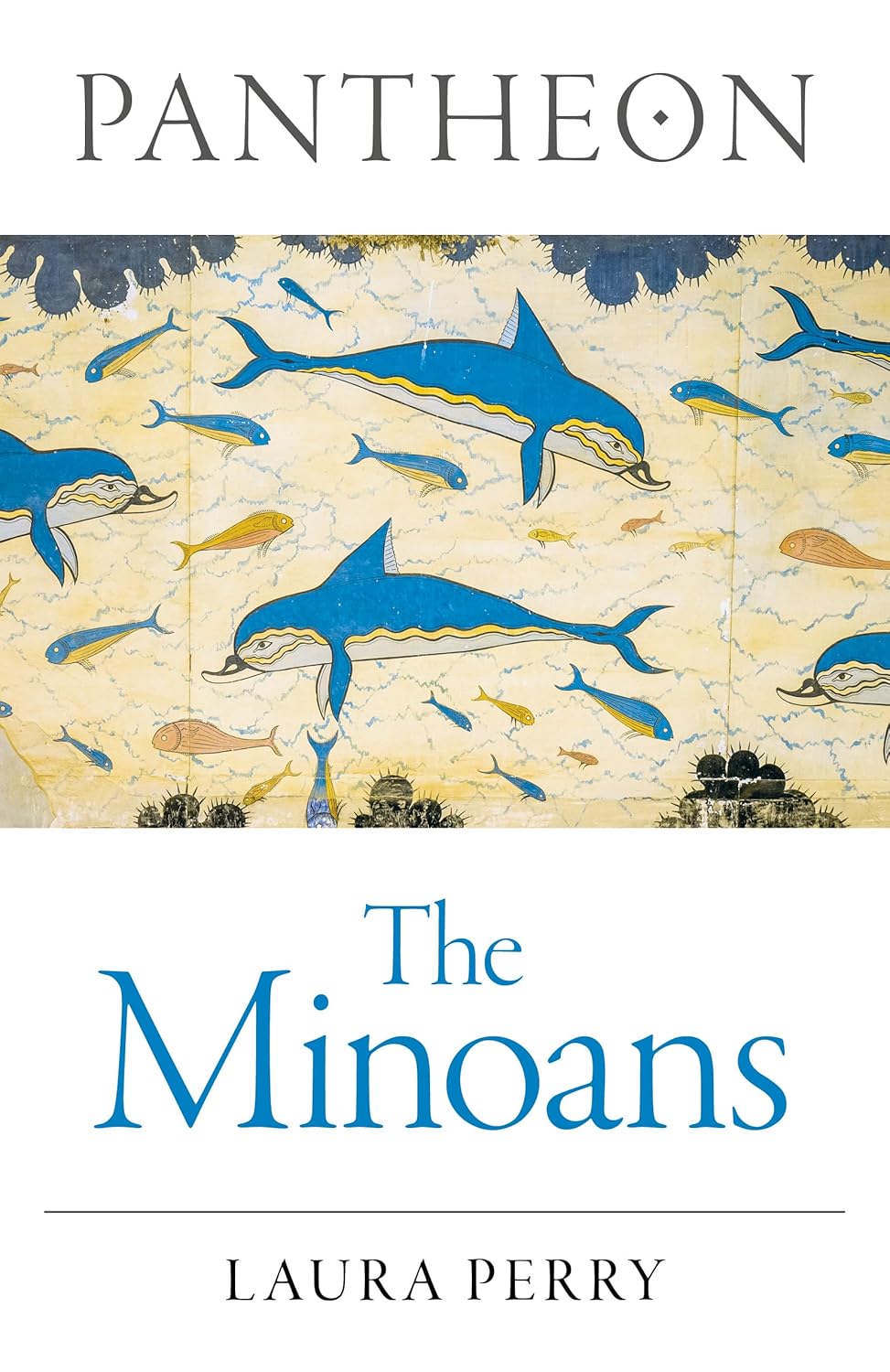
[Today we sit down for Five Questions with author, Laura Perry. Here, she discusses her new book on the Minoan pantheon, her collection of Minoan myths, and her upcoming projects. Editor’s Note: links have been provided below to various wikipedia entries; please note that these articles rely heavily on Hellenic interpretations of the various Mysteries and Deities, which differ from the Minoan. Curious readers should consult Perry’s writings for a clearer understanding of Minoan spirituality.]
Forests Haunted By Holiness: Your new book, Pantheon: The Minoans, will be available the last week of August. Congratulations! First, how did this book come about? Why a book about the Deities of ancient Crete?
Laura Perry: The Moon Books Pantheons series already included several titles involving better-known pantheons (Irish, Norse, and Egyptians), and the publisher was looking for representation from some of the less-well-known pantheons. The Minoans are often glossed over in history books, if they’re even mentioned at all. And the deities of ancient Crete aren’t terribly well known in the Pagan community except for the few who were borrowed into the later Hellenic pantheon. So I’m excited to be a part of this series and to showcase the work that the Ariadne’s Tribe community has done to reconstruct this pantheon, weaving these beautiful ancient deities into the tapestry of the modern world.
I’d like to emphasize here that Ariadne’s Tribe, and the pantheon and practices in Pantheon: The Minoans, represent a fully inclusive spiritual tradition. I like to point that out because many people are only aware of Minoan-themed spiritual traditions that are exclusive to certain genders or sexualities. What you’ll find in Pantheon: The Minoans is for everyone.
FHBH: What sort of research went into Pantheon: The Minoans? Long hours at the library? Lengthy discussions with scholars?
LP: Inclusive Minoan paganism is a long-term project that I’ve been working on for more than a decade. When Moon Books published the first edition of my book Ariadne’s Thread way back in 2013, a community of interested people began gathering with me and working on this revivalist spirituality. It was never just me; you could say I’m the project manager. The Tribe calls me their Temple Mom. Officially I’m the founder of Ariadne’s Tribe, and I’ve certainly been the driving force behind much of it. But we’ve all worked together to collect up information via archaeology, dance ethnology, and comparative mythology. That still left a lot of gaps, which we filled in with shared gnosis. Then we “road tested” the rituals and practices we developed, to be sure the deities were happy with them, and tweaked them as necessary based on that feedback. I’ve been delighted to lead Minoan rituals at a number of Pagan festivals and conferences, to introduce our unique ritual format to the broader Pagan community.
Pantheon: The Minoans is the third book I’ve written about Minoan spirituality, as well as the most comprehensive.
FHBH: Was there one fascinating or unusual fact or myth or curiosity that you absolutely had to include in the book?
LP: Scholars think there was an early or precursor version of the Eleusinian Mysteries among the Minoans, so that’s one of the first things we began researching. We eventually came up with a beautiful myth cycle involving, not Demeter and Persephone, but the Minoan goddesses Rhea and Ariadne. Unlike the Hellenic version, the Minoan myth doesn’t involve abduction. Instead, Ariadne freely and willingly returns to the Underworld for a part of each year in order to lovingly care for the spirits of the dead. In addition to being the Lady of the Labyrinth, she is also the Queen of the Dead. Since time passes differently in the Underworld than it does in the World Above, her mother Rhea descends to find her when it’s time for her to return to the World Above.
The Minoan mythos is intricately interwoven with the sacred calendar, so I’ve included the story of the Mysteries in the calendar section of Pantheon: The Minoans, at the appropriate time of the year for the Mediterranean climate, which is a good bit different from the northern temperate zone that many of us live in.
FHBH: You also recently published Tales From the Labyrinth: Modern Minoan Myths. Are these retold myths or original stories? And which did you have the most fun writing, and why?
LP: These are original stories that also contain some ancient myth fragments, so they’re based on both research and shared gnosis about the Minoan deities. As I mentioned earlier, the mythos is intricately interconnected with the sacred calendar, so journeying through this collection of tales takes you not just back to ancient Crete but also around the Minoan wheel of the year.
As for which story was the most fun to write, that’s a hard question to answer. I’ve done basic writeups of the mythos before, both in “straight” nonfiction format and in ritual format. But this was the first time I put them in storytelling form, like you might read out loud to your family on a cozy evening. So that aspect of the project was quite delightful!
I think the story I had the most fun writing is the one called “The Dance,” which is about three of the Minoan deities who teach us to embrace the joy in life. The god Korydallos, the goddess Thumia, and the god Kaulo remind us that physical incarnation in the material world is a gift that’s meant to be enjoyed and savored, in connection with each other and with the deities. One of our sayings in Ariadne’s Tribe is, “Together we are joy!”
FHBH: What other projects are you working on?
LP: Over the past fourteen years, I’ve published fourteen books (including several fully revised second editions of previous titles), a Minoan coloring book, and a Minoan Tarot deck with a full-size companion book, as well as collaborating on another Tarot project for which I wrote the companion book. So I’m actually going to take a little time off now, to work on some sacred art projects. But I do have a couple partially-written book projects waiting in the wings that I’ll pick up again once I’ve had a breather. I’ll be turning to fiction this time. One project is a historical novel set in Amarna-era ancient Egypt, involving some familiar names: Nefertiti, Akhenaten, and Tutankhamun. The other project is a modern murder mystery set in the north Georgia (USA) mountains and entangled with the kind of folk magic that I grew up with, including run-ins with the spirits of the dead and some tricksy live humans as well. This won’t be my first fiction. I’ve already written an urban fantasy, a Minoan historical novel, and a Minoan gay romance. Those were a lot of fun to write, so I’m looking forward to completing these next two novels.
 Eternal Haunted Summer