
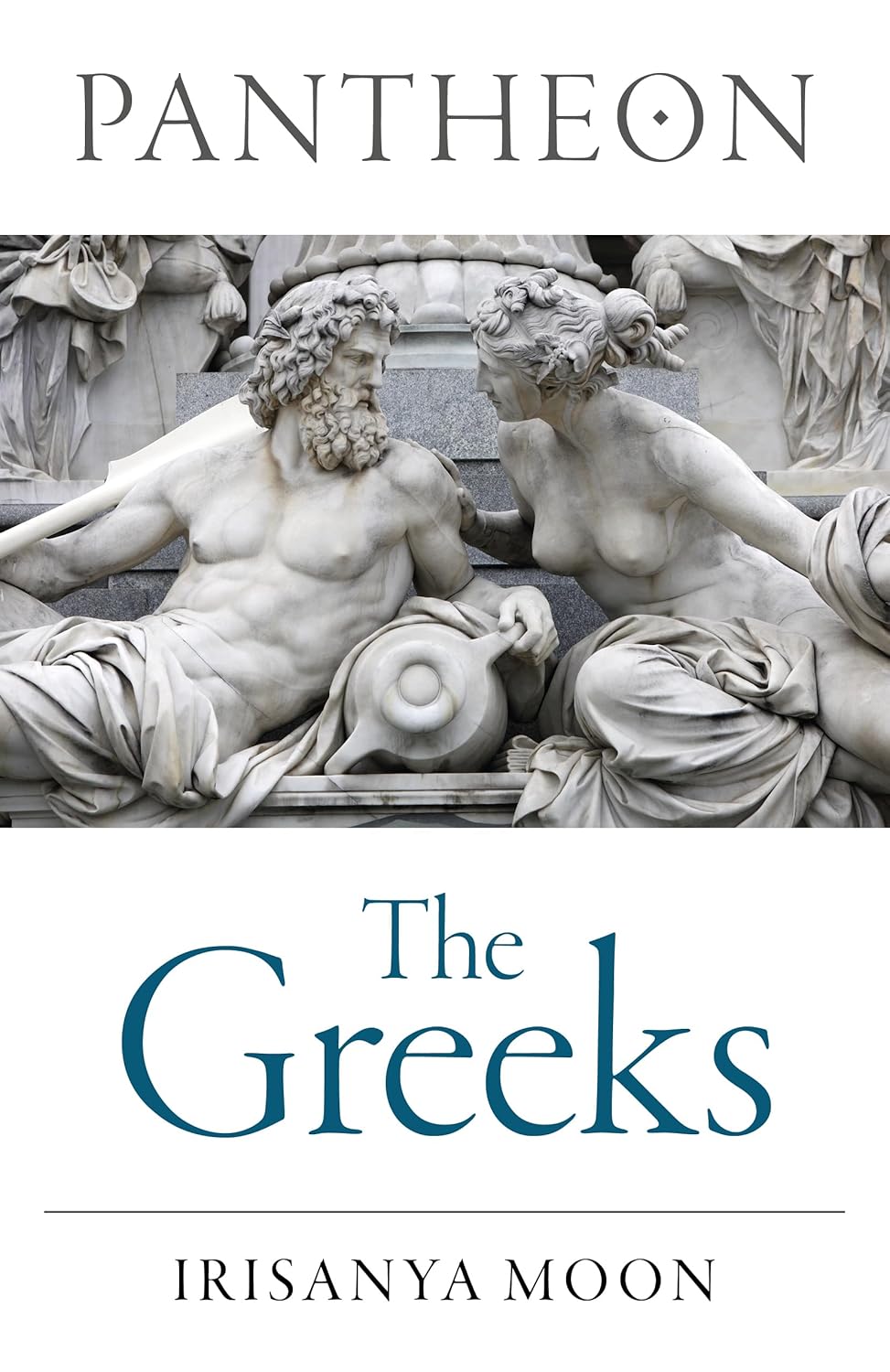
[Here, we sit down for Five Questions with author Irisanya Moon, and discuss their new book, Pantheon: The Greeks.]
Forests Haunted by Holiness: Your next book, Pantheon: The Greeks, will be published by Moon Books in December. First, congratulations! Second, why the Greek pantheon? Why did you feel it was important to write such a book?
Irisanya Moon: Thanks! This book is one that’s been in the back of my mind for a while, not only to add to the Moon Books’ Pantheon series, but also to offer a foundation for readers or would-be readers of other Greek deity books. Knowing where these stories began and why they still resonate allows readers to locate themselves in the Greek myths, and to deepen related spiritual practices. In my mind, Greek mythology has offered a template for building relationships with divine beings, seeing them more as relatable figures than impossible-to-impress parental figures.
FHBH: What sort of research went into the book? Big piles of texts? Long discussions with devotees and scholars?
IM: My typical research process begins with taking all of my Greek mythology and history books off my shelves, tabbing pages that speak to what I want to cover in the table of contents, and then seeing what resources I still need. I tend to borrow or purchase used books to help uncover more viewpoints and research, as well as seek out reliable online resources for additional information, bookmarking them for later review and organization. Mostly, my research looks like big piles of books in my living room, where I most often write my books. And since I’ve been writing about Greek mythology for a bit, it’s easier for me to bring in details I already know — and then double check myself and cite sources along the way. This book has many, many citations and footnotes to ensure readers not only understand why I’ve shared what I shared, but also have places to explore on their own.
FHBH: There are many, many Deities in the Greek pantheon. While many people are familiar with the twelve Olympians, which “lesser” Deity or being did you feel compelled to include, and why?
IM: Writing about the Greek pantheon often highlights the Olympians, but there were primordial deities (aka the ones who started the universe) and the Titans (aka the ones born of these original beings and then birthed the Olympians). Along the way are many minor deities, demigods, creatures, energies, etc., and I wanted to bring in a few things that can be overlooked: Hecate (as a Titan who was highly respected by Zeus); the various spirit personifications (e.g., Peitho, or persuasion, as an ally of Aphrodite); and other deities and beings that people may not have heard of. Many of which I hadn’t heard of until my research. I certainly didn’t include everyone, and that’s one of the neat things about Greek mythology: there’s always more to learn.
FHBH: In addition to your own, which books do you think those interested in the Greek pantheon should absolutely read?
IM: In the book, I have a lengthly section of sources and recommended resources, and here are some standouts that offer foundational information, primary and secondary sources, modern practices and gnosis, and more.
Buxton, Richard. Greek Myths & Tales: Epic Tales. Flame Tree Collections. 2018.
Homer. The Iliad. Translated by Emily Wilson. W.W. Norton & Company. 2023.
Homer. The Odyssey. Translated by Emily Wilson. W.W. Norton & Company. 2017.
Johnston, Sarah Iles. Gods and Mortals: Ancient Greek Myths for Modern Readers. Princeton University Press. 2023.
Lefkowitz, Mary. Greek Gods, Human Lives: What We Can Learn from Myths. Yale University Press. 2003.
Mankey, Jason & Astrea Taylor. Modern Witchcraft with the Greek Gods: History, Insights & Magickal Practice. Llewellyn Publications. 2022.
Matyszak, Philip. The Gods and Goddesses of Greece & Rome. Thames & Hudson. 2022.
Parin D’aulaires, Ingri and Edgar. D’aulaires’ Book of Greek Myths. Bantam Doubleday Dell Publishing Group. 1962.
Rayor, Diane J. The Homeric Hymns: A Translation, with Introduction and Notes. University of California Press. 2014.
Trzaskoma Stephen M., Scott R. Smith, and Stephen Brunet. Anthology of Classical Myth: Primary Sources in Translation. Hackett Publishing Company. 2016.
FHBH: What other projects are you working on?
IM: I’ve just wrapped up a second book on Aphrodite, including thirteen months of practice with a few of her epithets. It’s a book that outlines the teachings and insights of an online priestess training I offer, so readers can do this work on their own or in a group.
I then completed a book on building relationships with divine beings, which I’m still editing.
And then I completed another Pagan Portals book on Zeus.
I’ve been writing a lot lately in preparation for starting grad school in 2026 in Australia, where I plan to bring in my knowledge of Greek mythology to inform investigations into how we approach narrative and storytelling in a digital landscape, including the influence of propaganda, AI, and myth retellings.
I still plan to teach and write along the way, so folks can follow what I’m up to on my website (www.irisanyamoon.com), Heart Magick substack (irisanya.substack.com), or my social media accounts.
 Eternal Haunted Summer